What Is Semantic SEO? How Modern Search Understands Content
Introduction: The Shift to Semantic SEO
In the early days of the internet, search engine optimization (SEO) was a relatively straightforward game of keyword density and backlinks. Website owners would meticulously ensure their target keywords appeared frequently on a page, often without much consideration for context or actual user value. However, the digital landscape has undergone a profound transformation, ushering in an era where search engines are far more sophisticated.
This evolution is driven by advancements in artificial intelligence and machine learning, fundamentally altering how content is indexed, understood, and ranked. The shift to semantic SEO represents a pivot from simple keyword matching to a deeper comprehension of user intent, the meaning behind queries, and the relationships between various pieces of information. It's about optimizing for understanding, not just words.

What is Semantic SEO? Defining the Core Concept
Semantic SEO is an approach to search engine optimization that focuses on optimizing content for meaning and context, rather than just individual keywords. It involves creating content that comprehensively covers a topic, answers user questions thoroughly, and establishes clear relationships between different concepts, often referred to as 'entities.' This strategy acknowledges that search engines are becoming increasingly adept at interpreting the nuances of human language.
At its heart, semantic SEO aims to help search engines understand the full meaning of a piece of content, much like a human would. This includes grasping the implied intent behind a search query, identifying the key entities discussed, and assessing the overall relevance and authority of the information provided. The goal is to provide the most accurate, comprehensive, and helpful answer to a user's underlying need, not just a page that contains a few matching words.
How Modern Search Engines Understand Content: AI, NLP, and Vector Embeddings
Modern search engines, particularly Google, employ an intricate array of technologies to move beyond superficial keyword matching. Artificial Intelligence (AI) and Natural Language Processing (NLP) are at the forefront of this revolution. NLP allows computers to process, understand, and generate human language, making sense of complex sentence structures, synonyms, and the overall context of a text.
Advanced NLP models, powered by deep learning, enable search engines to identify the core entities within content—people, places, things, concepts—and understand the relationships between them. This deeper understanding is crucial for delivering highly relevant search results. They can discern user intent, even if the query is vague or uses colloquialisms, by analyzing patterns and contextual cues across billions of web pages.
A key innovation in this area is the use of vector embeddings. These are numerical representations of words, phrases, or even entire documents in a multi-dimensional space. Words or concepts with similar meanings are mapped closer to each other in this space. When a user types a query, the search engine converts it into a vector, then searches for content vectors that are 'close' to the query vector, indicating semantic similarity. This allows search engines to match queries to content that doesn't explicitly contain the exact keywords but is semantically relevant.

The Role of Google's Knowledge Graph and Entities
Central to Google's semantic understanding is its Knowledge Graph. Launched in 2012, the Knowledge Graph is a massive database of entities and the relationships between them. An entity is a distinct, well-defined concept or thing—it could be a person, a place, an organization, a product, or an abstract idea. The Knowledge Graph maps these entities and their attributes, providing context and factual information directly within search results and underpinning how Google understands the world.
When you search for a famous person, the Knowledge Graph might display a direct answer box with their birthdate, profession, and related entities (like their spouse or works). This rich, interconnected web of information allows Google to answer complex queries and draw inferences. For example, if you search 'capital of France,' Google doesn't just find pages with those words; it knows 'France' is a country entity and 'Paris' is its capital entity, retrieving factual information directly from its graph. Google's Knowledge Graph expanded significantly, growing from 570 million entities to 8 billion entities and 800 billion facts in less than a decade, showcasing its exponential growth and importance.
Optimizing for entities means ensuring that your content clearly identifies and discusses relevant entities, using structured data (like Schema Markup) where appropriate to help search engines categorize and understand them. This clarity helps search engines connect your content to the broader web of knowledge.
Key Google Algorithm Updates Shaping Semantic Search (Hummingbird, RankBrain, BERT, MUM)
Google's journey towards semantic understanding has been marked by several pivotal algorithm updates. Each update built upon the last, progressively enhancing the search engine's ability to interpret queries and content with greater sophistication.
| Year | Event |
|---|---|
| 2001 | Tim Berners-Lee introduces the concept of the Semantic Web to make data machine-readable. |
| 2010 | Google acquires Metaweb, laying the groundwork for the Knowledge Graph. |
| 2013 | Hummingbird update focuses on understanding the meaning behind entire search queries, not just individual keywords. |
| 2015 | RankBrain, an AI and machine learning system, becomes a key part of Google's ranking algorithm, particularly for ambiguous queries. |
| 2019 | BERT (Bidirectional Encoder Representations from Transformers) allows Google to better understand the nuances and context of words in search queries. |
| 2021 | MUM (Multitask Unified Model) expands on BERT, enabling multi-modal understanding and more complex, cross-language information synthesis. |
**Hummingbird (2013):** This was a complete overhaul of Google's core algorithm, shifting focus from keywords to understanding the meaning of entire phrases and natural language queries. It allowed Google to interpret conversational queries more effectively.
**RankBrain (2015):** An AI and machine learning component, RankBrain helped Google process never-before-seen queries (estimated at 15% of daily searches). It interprets the implied meaning of queries and associates them with related concepts, improving results for ambiguous searches.
**BERT (2019):** Bidirectional Encoder Representations from Transformers dramatically improved Google's understanding of the context of words within a search query. It allowed Google to grasp nuances like prepositions and their impact on meaning, leading to more relevant results for complex searches.
**MUM (2021):** The Multitask Unified Model represents an even more advanced leap, capable of understanding information across multiple languages and modalities (text, images, video). MUM aims to answer highly complex questions that would typically require multiple searches, synthesizing information from diverse sources to provide a comprehensive answer.
Core Pillars of Semantic SEO: User Intent, Topic Clusters, and Entity-Based Content
To excel in the semantic era, SEO strategies must focus on three interconnected pillars that prioritize user value and deep content understanding.
**User Intent:** This is perhaps the most critical component. Instead of just identifying keywords, semantic SEO demands that we understand *why* a user is searching. Are they looking for information (informational intent), trying to buy something (transactional intent), navigating to a specific website (navigational intent), or comparing options (commercial investigation)? Aligning content perfectly with user intent ensures relevance and satisfaction, which are major ranking factors.
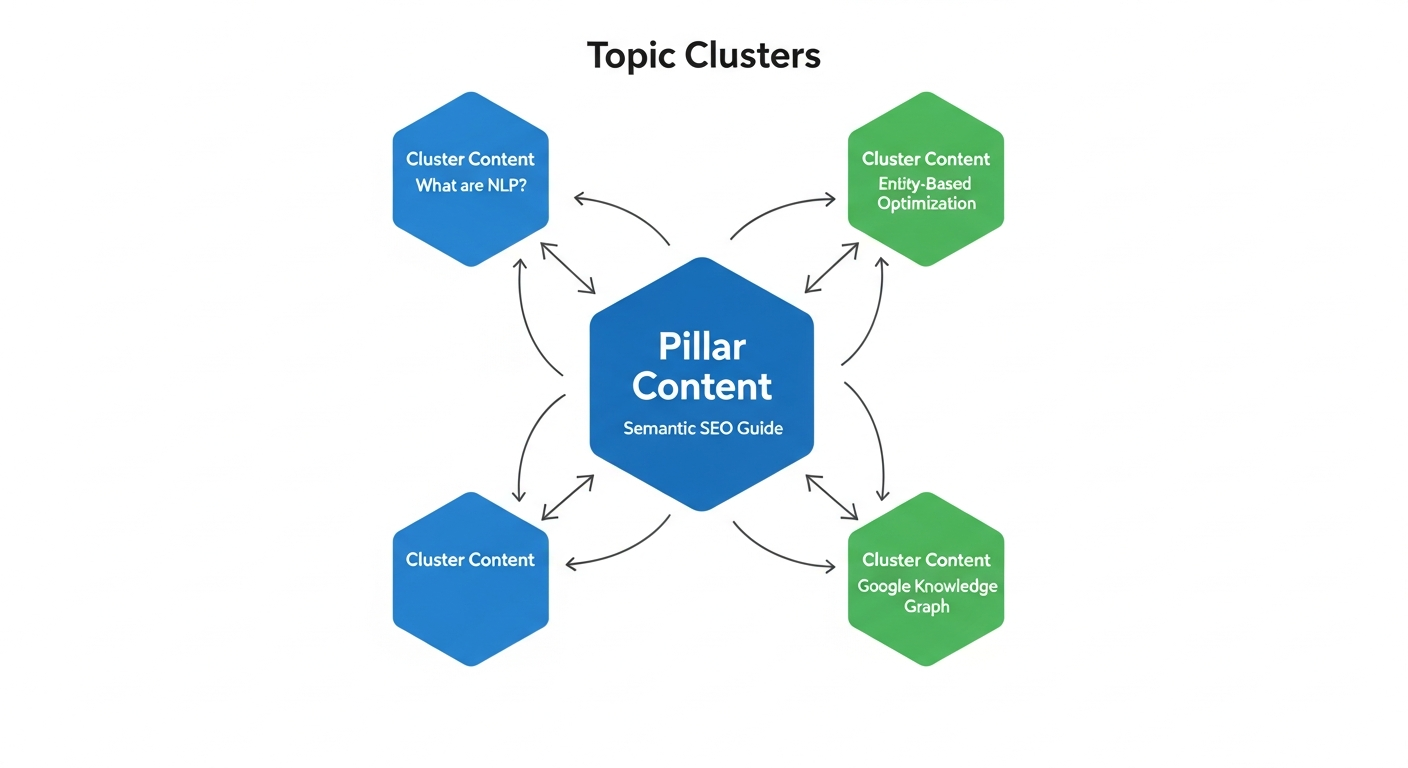
**Topic Clusters:** This organizational strategy moves away from optimizing individual pages for single keywords. Instead, you create a comprehensive 'pillar page' that broadly covers a core topic, and then numerous 'cluster pages' that delve into specific subtopics in detail, linking back to the pillar page. This structure signals to search engines that your site is an authority on the overarching topic, strengthening its semantic relevance and helping users navigate related content efficiently.
**Entity-Based Content:** As discussed, entities are the building blocks of semantic understanding. Creating entity-based content means identifying the key entities relevant to your topic and ensuring they are thoroughly explained, disambiguated, and connected within your content. This involves using structured data, mentioning related entities, and providing comprehensive coverage of the chosen subject. Research suggests that entity-based content can deliver up to 1400% better search visibility, underscoring its profound impact on performance.
Benefits of Implementing Semantic SEO
Adopting a semantic SEO strategy offers a multitude of advantages that go beyond simply improving rankings; it fundamentally enhances the value proposition of your online presence.
- Improved Search Visibility and Rankings: By aligning content with user intent and comprehensively covering topics, websites are more likely to rank for a wider array of relevant queries, including long-tail and conversational searches.
- Higher Quality Organic Traffic: Content that truly understands and addresses user intent attracts visitors who are genuinely interested in the information or solution provided, leading to lower bounce rates and higher engagement.
- Enhanced User Experience: Providing comprehensive, well-structured, and contextually rich content makes for a better experience for visitors, fostering trust and authority. Users find answers quickly and efficiently.
- Future-Proofing SEO Strategy: As search engines continue to evolve with AI and machine learning, a semantic approach ensures your content remains relevant and effective, less susceptible to minor algorithm tweaks that might penalize keyword-stuffing tactics.
- Increased Authority and Brand Recognition: Consistently producing high-quality, semantically rich content positions your brand as an expert and authoritative source in your niche, building trust and thought leadership.
- Better Performance in AI Overviews and Featured Snippets: Content that directly and comprehensively answers questions is more likely to be selected by Google's generative AI features. AI Overviews currently trigger for 18.76% of keywords in US SERPs, highlighting the importance of clear, concise, and semantically optimized answers.
Recent Developments and Future Trends: AI Integration, Voice Search, and E-E-A-T
The trajectory of semantic SEO is closely intertwined with the rapid advancements in artificial intelligence. AI's pervasive integration into search is not just a trend but the foundational shift that continues to redefine how content is created and optimized. Generative AI, for instance, is increasingly used to summarize search results or even create entire content pieces, making the underlying semantic understanding even more critical for visibility.
Voice search is another significant area where semantic understanding is paramount. People speak differently than they type, using more natural, conversational language. Semantic SEO ensures that content can be understood by these voice assistants, which rely heavily on accurately interpreting spoken queries and matching them to semantically relevant information. Optimizing for long-tail, question-based queries becomes even more important here.
Furthermore, the concept of E-E-A-T (Experience, Expertise, Authoritativeness, Trustworthiness) is more critical than ever. Google explicitly emphasizes these quality signals, particularly for YMYL (Your Money Your Life) topics. Semantic SEO contributes to E-E-A-T by encouraging comprehensive, fact-checked, and well-attributed content that showcases genuine knowledge and credibility. Establishing oneself as a reliable entity through consistent, high-quality, and semantically rich content is key to long-term success.
Key Data Points and Statistics on Semantic Search
The impact of semantic search is not merely theoretical; it is demonstrably reshaping the SEO landscape and delivering measurable results for those who adapt. These statistics underscore the critical nature of semantic optimization:
- AI Overviews (formerly Search Generative Experience or SGE) currently trigger for an estimated 18.76% of keywords in US SERPs following Google's generative AI integration. This indicates a significant portion of queries now benefit from or require content optimized for AI summarization and understanding.
- Google's Knowledge Graph expanded from approximately 570 million entities in its initial launch to an astounding 8 billion entities and 800 billion facts in less than a decade. This exponential growth highlights Google's continuous investment in and reliance on entity-based understanding to power its search results.
- Research suggests that entity-based content can deliver up to 1400% better search visibility compared to content that is not optimized for entities. This dramatic difference emphasizes the profound competitive advantage gained by structuring content around concepts and relationships Google understands.
- Approximately 15% of all daily searches on Google are new queries that have never been seen before. Algorithms like RankBrain and BERT, powered by semantic understanding, are crucial for interpreting these novel queries and providing relevant results, highlighting the inadequacy of keyword-only approaches.
Expert Perspectives on Semantic SEO
Industry leaders and SEO specialists consistently emphasize the shift towards semantic understanding as the paramount strategy for future-proof SEO. Many experts agree that focusing on user intent and comprehensive topic coverage is no longer just a best practice, but a prerequisite for visibility. Dr. Peter J. Meyers, Marketing Scientist at Moz, has frequently highlighted the importance of 'answering the question behind the question,' a core tenet of semantic search.
Rand Fishkin, co-founder of SparkToro, often advises that SEOs should 'optimize for topics, not keywords,' further cementing the move towards a more holistic, entity-based approach. The consensus among thought leaders is that as AI evolves, the ability of search engines to understand complex language will only deepen, making semantic optimization the most resilient and effective long-term strategy for content creators and businesses.
Additionally, industry veterans like Barry Schwartz of Search Engine Roundtable regularly report on Google's continued advancements in AI and NLP, consistently reinforcing the message that pure keyword matching is obsolete. The emphasis is now on creating content that is genuinely helpful, authoritative, and structured in a way that machines can easily interpret its underlying meaning and context.
Practical Strategies for Semantic SEO Optimization
Implementing semantic SEO requires a strategic shift in how content is planned, created, and structured. Here are actionable strategies to optimize your content for modern search engines:
- Conduct Intent-Based Keyword Research: Move beyond simple keywords. Research the questions users ask, the problems they want to solve, and the different stages of their buying journey. Tools that identify related topics and questions are invaluable here.
- Develop Comprehensive Topic Clusters: Identify core topics relevant to your niche and create pillar pages that cover them broadly. Then, create numerous detailed cluster content pages that dive into specific subtopics, all interlinked to establish topical authority.
- Incorporate Related Entities and Concepts: When writing, actively include relevant entities (people, places, organizations, ideas) and related concepts that naturally enrich the topic. Don't just mention a keyword; explain the surrounding context.
- Utilize Structured Data (Schema Markup): Implement Schema Markup to explicitly tell search engines what your content is about. This helps them understand entities, facts, and relationships more precisely, improving visibility in rich results and AI Overviews.
- Focus on E-E-A-T: Build and demonstrate Experience, Expertise, Authoritativeness, and Trustworthiness. Ensure content is well-researched, fact-checked, cited, and attributed to credible authors with relevant credentials. Update content regularly.
- Optimize for Conversational Search: Structure your content to naturally answer common questions and provide direct, concise answers, which is crucial for voice search and AI-driven summaries.
- Improve Internal Linking: Create a robust internal linking structure that connects semantically related content across your site. This helps search engines understand the relationships between your pages and distributes link equity.
Conclusion: Adapting to an Evolving Search Landscape
The evolution of search engines from keyword-matching machines to sophisticated semantic interpreters represents one of the most significant shifts in the history of SEO. With the relentless pace of AI and NLP advancements, the ability of platforms like Google to understand meaning, context, and user intent will only continue to deepen. Semantic SEO is not merely a passing trend; it is the fundamental framework for success in the modern and future search landscape.
By embracing user intent, structuring content around comprehensive topic clusters, and focusing on entity-based content, businesses and content creators can build resilient, high-performing SEO strategies. Those who continue to adapt to this evolving landscape, prioritizing genuine user value and deep contextual understanding, will be the ones who consistently capture visibility, drive quality traffic, and establish lasting authority in their respective niches. The future of search is semantic, and the time to optimize for meaning is now.
Frequently Asked Questions
What is the primary difference between traditional SEO and Semantic SEO?
Traditional SEO primarily focused on matching keywords and phrases, often in isolation, to gain rankings. Semantic SEO, in contrast, focuses on understanding the meaning, context, and intent behind a user's query and the comprehensive topic of the content, moving beyond exact keyword matches to a deeper, more human-like comprehension.
How do search engines identify entities in content?
Search engines use advanced Natural Language Processing (NLP) techniques, machine learning, and vast databases like Google's Knowledge Graph. NLP algorithms can recognize and extract specific 'entities' (people, places, concepts, organizations) from text, disambiguate them, and understand their relationships based on context, structured data (Schema Markup), and cross-referencing with their knowledge bases.
Is keyword research still relevant in Semantic SEO?
Yes, keyword research is absolutely still relevant, but its focus has shifted. Instead of just looking for high-volume keywords, semantic keyword research involves understanding user intent, identifying related topics and subtopics, and discovering the various ways users express a need. It becomes more about 'topic research' and 'intent research' to build comprehensive content strategies.
What is E-E-A-T and why is it important for semantic search?
E-E-A-T stands for Experience, Expertise, Authoritativeness, and Trustworthiness. It's a set of quality signals Google uses to evaluate the credibility and reliability of content and its creators, especially for 'Your Money Your Life' topics. Semantic SEO contributes to E-E-A-T by encouraging the creation of comprehensive, well-researched, fact-checked content that clearly demonstrates a deep understanding and reliable sources, thereby building trust and authority.
How does semantic SEO impact my website's overall performance?
Implementing semantic SEO can significantly boost your website's performance by improving search visibility for a broader range of relevant queries, attracting higher-quality organic traffic, and enhancing user experience with more comprehensive content. It also helps future-proof your SEO strategy against algorithm changes and builds your brand's authority as a trusted source of information in your niche.